I ran an AI on a $2B repo. Here is what it found.
Mar 14, 2026
I did not expect much.
I built Ryva to surface project state from GitHub and Slack. Decisions made, missing decisions, blockers, next actions. I have been using it on my own projects for weeks. But I wanted to see what would happen on a real repo. One I did not control. One with hundreds of contributors and millions of users depending on it.
So I ran it on Supabase.
What it found
The output came back with six open decisions. Not feature requests. Not old tech debt. Active problems with no owner, no fix timeline, no explicit next step.
- A Realtime presence regression breaking production apps since March 5 with nobody assigned
- An auth deadlock silently failing sign-in on mobile with no workaround published
- A self-hosted Studio crash sitting open since November 2025
None of this was hidden. Every issue was publicly visible in the repo. What surprised me was that none of them had a decision attached. The information existed. The ownership did not.
What two weeks of conversations taught me
I spent the last two weeks talking to engineering managers and founders about standups. Over a hundred conversations across Reddit, Slack communities, and LinkedIn. The pattern I kept hearing was the same.
Nobody said their standup was useless. Most people defended it. But when I asked where important decisions actually lived, the answers were always the same:
- Slack threads
- PR comments
- Someone’s memory
One engineering manager described his mornings like this:
It feels like archaeology. Digging through commits and Slack threads just to understand what changed overnight.
Another called their standups a forensics exercise.
The standup reconstructs context. It does not capture it.
The real problem
Here is what I think is actually happening in most teams.
The problem is not the meeting. The problem is that project state lives everywhere except somewhere reliable. So the meeting becomes the only moment where someone assembles it out loud. Remove the meeting and you do not get visibility. You get archaeology twice a day instead of once.
The decisions that matter most are not the ones people make explicitly. They are the ones nobody realizes need to be made:
- The question the team is avoiding
- The assumption everyone is making silently
- The ownership gap that will hurt the sprint in three weeks that nobody has named yet
Those never come up in standups. They come up when something breaks.
What I built
Ryva is my attempt to surface that layer automatically. Not to replace the meeting. To make the meeting optional for the parts that do not need it.
The Supabase output is live at ryva.dev/demo. No signup required. You can see exactly what the agent found and judge whether it would have been useful to your team.
I also ran Ryva on a Next.js repo to compare how the same workflow looks on a different codebase.
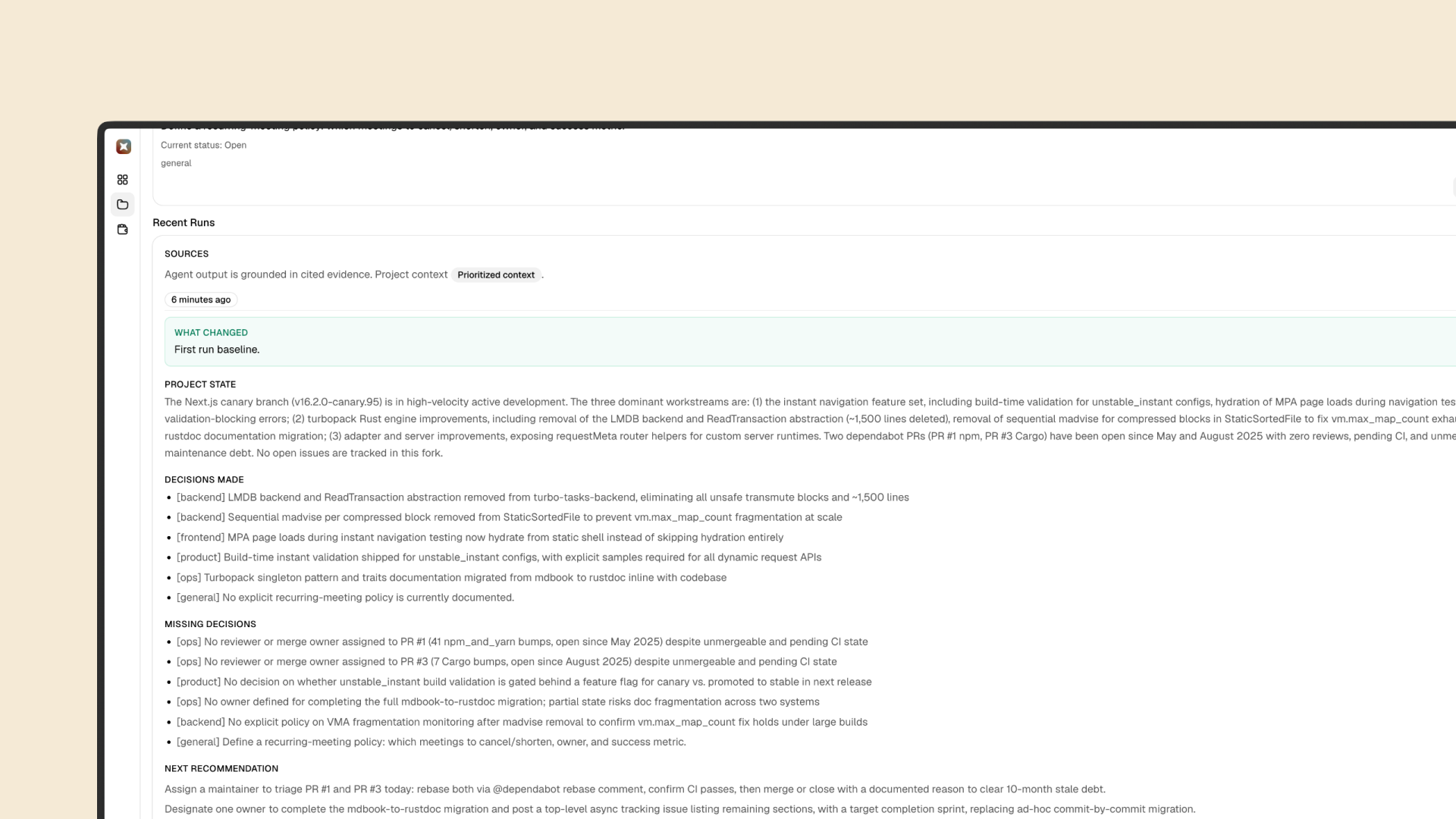
I write about the build every day in the diary, so if you want the raw day-by-day version of how this is evolving, that is where it lives.
I am still early. No paying customers yet. But the Supabase run was the first time I looked at the output and thought: this would have actually mattered to someone.